


introduction
Have you ever paused to watch an elite athlete navigate a crowded field, changing direction seamlessly on a field or court, and wondered how they move so effortlessly? That remarkable ability to slip past an opponent, stop on a dime, and burst into a sprint is not just a natural gift or an accident of genetics. Instead, it is the direct, measurable result of deliberate, structured physical conditioning. Whether you want to improve your performance in local competitive sports leagues, enhance your reaction times for recreational activities, or simply wish to enhance your daily functional fitness, mastering speed and agility training exercises can completely transform how your body moves through space.
Many people carry the mistaken belief that explosive quickness and sharp reflexes are traits you are either born with or not. We often look at professional sports stars and assume their lightning-fast footwork is an unchangeable genetic inheritance. However, modern sports science consistently demonstrates that you can significantly upgrade your coordination, acceleration, and balance through targeted movement drills, regardless of your starting point. This comprehensive guide will break down the essential concepts of quickness conditioning, providing you with practical, accessible workouts that build a faster, more responsive, and highly resilient body.
To truly understand the value of this training style, it helps to look at how our bodies interact with the environment. Every day, your muscles and joints encounter forces that require split-second adjustments. When you slip on an icy patch of sidewalk, trip over a loose rug, or reach out to catch a falling object, your nervous system must react instantly to keep you upright. Traditional gym workouts, while excellent for building raw muscle mass or improving cardiovascular endurance, often train the body in a single, predictable plane of motion. Lifting weights on a machine or running at a steady pace on a treadmill teaches your muscles to move along a fixed path. While this builds strength, it fails to prepare your musculoskeletal system for the chaotic, unpredictable movements of real life and dynamic sports.
This is exactly where specialized movement training enters the picture. By introducing multi-directional drills into your weekly routine, you force your brain and your body to communicate at an accelerated rate. You are essentially teaching your nervous system to map out space more efficiently, allowing your muscles to contract with greater speed and precision. For beginners, this type of training lays a rock-solid foundation of physical literacy, helping you feel more confident and stable in your movements. For intermediate fitness enthusiasts, it provides the missing link that converts raw gym strength into explosive, functional power that directly carries over to the soccer field, the basketball court, or the tennis arena.
Furthermore, committing to a structured agility routine acts as a powerful insurance policy for your joints. As we age or increase our workout intensities, the risk of acute injuries like ankle sprains, knee twists, and muscle strains naturally rises. These injuries almost always occur when the body is forced into a sudden, unexpected change of direction that the stabilizing muscles are not strong enough to handle. By practicing controlled stop-and-go movements in a safe training environment, you gradually fortify the ligaments, tendons, and small stabilizing muscle groups surrounding your primary joints. This creates a deeply resilient physical framework capable of absorbing high-impact forces without breaking down.
It is also worth noting that speed and agility training exercises offer an incredibly engaging and refreshing alternative to standard cardiovascular workouts. Many people eventually find themselves stuck in a fitness rut, growing bored with long, monotonous sessions on stationary bikes or elliptical machines. Movement drills completely eliminate this boredom by requiring your absolute focus and mental presence. You cannot easily daydream while navigating an intricate footwork pattern on an agility ladder or timing a sharp turn around a series of plastic cones. This high level of mental engagement not only makes your workouts fly by much faster, but it also provides a unique cognitive workout that sharpens your focus, spatial awareness, and overall mental clarity.
Ultimately, physical quickness is a skill that can be studied, practiced, and mastered over time. It does not require an expensive gym membership, high-tech athletic gear, or a background in professional sports to begin. All it takes is an open space, a handful of simple markers, and a willingness to step outside your comfort zone. By shifting your focus away from simply how much your muscles can lift and toward how efficiently your body can move, you open the door to a completely new level of physical freedom and athletic capability. Let us dive deeper into the core mechanics of this transformative training philosophy and explore how you can safely build a quicker, more dynamic body from the ground up.
What is Speed and Agility Training?
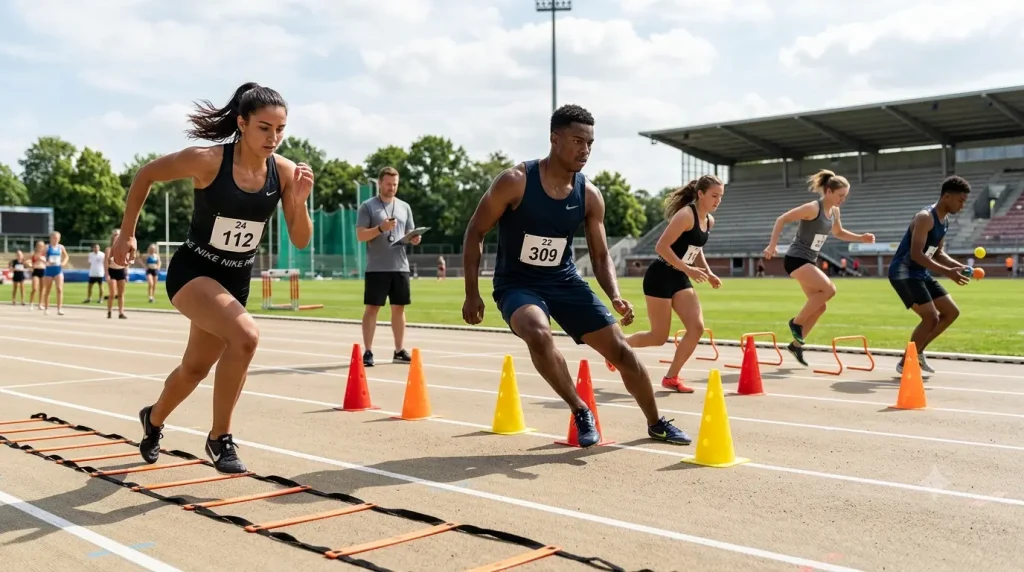
Speed and agility training is a specialized form of physical conditioning designed to improve your quickness, acceleration, deceleration, and directional control. While people often use these terms interchangeably, they represent distinct physical capabilities that work together to create efficient athletic movement.
+-----------------------------------------------------------------+
|                    ATHLETIC QUICKNESS                           |
+-------------------------------+---------------------------------+
                                |
        +-----------------------+-----------------------+
        |                                               |
        v                                               v
  LINEAR SPEED                                   DYNAMIC AGILITY
(Moving straight, fast)                     (Changing direction safely)
Linear speed refers to your ability to move your body from point A to point B in a straight line in the shortest possible time. It relies heavily on explosive power, stride length, and stride frequency. When you run a straight sprint, you are demonstrating linear speed.
Dynamic agility, on the other hand, is the ability to change the position of your body efficiently and under complete control. It requires you to rapidly decelerate, shift your center of gravity, and accelerate in a completely new direction. True agility also involves a cognitive element, meaning your brain must process a visual cue and signal your muscles to react instantly.
When you combine these elements with quickness, which is the immediate, non-reactive explosive power of your first step, you get a highly functional body. This training conditions your nervous system to fire rapidly, ensuring that your muscles contract with maximum efficiency.
Why is Speed and Agility Training Important?

Engaging in speed and agility training exercises is essential because it bridges the gap between traditional strength and real-world movement. Lifting weights builds raw muscle mass, but movement conditioning teaches your brain how to utilize that muscle power with precision.
First, this type of training significantly enhances neuromuscular coordination. Your brain learns to communicate with your muscle fibers at an accelerated rate, which shortens your reaction time. This means you can move your feet quicker and respond to physical obstacles with much greater ease.
Second, dynamic movement drills improve your spatial awareness and balance. By forcing your body to move sideways, backwards, and diagonally, you strengthen the stabilizer muscles around your ankles, knees, and hips. This multidimensional conditioning ensures that you remain steady on your feet during complex physical tasks.
Finally, these exercises provide an incredible cardiovascular workout. The stop-and-go nature of these drills mimics high-intensity interval training, which boosts your metabolic rate and burns calories efficiently. It keeps your workouts engaging and highly functional.
Detailed Step-by-Step Guide to Speed and Agility Training Exercises
To get the most out of your speed and agility training exercises, you must perform them with correct technique. Below is a detailed breakdown of the best drills for beginner and intermediate fitness enthusiasts.
1. The Lateral Ladder Shuffle
This drill is excellent for developing foot speed, lateral coordination, and ankle stability. It teaches you how to maintain a low, athletic base while moving sideways.
[ ] -> [1][2] -> [3][4] -> [5][6] -> (Move laterally through spaces)
- Setup: Lay a standard 10-foot agility ladder flat on the ground in an open area. Stand at the left end of the ladder, facing forward so the ladder runs horizontally beside you.
- Execution: Drop into a slight quarter-squat position with your hands up. Step your right foot into the first square, quickly followed by your left foot. Next, step your right foot out into the second square, followed immediately by your left foot.
- Progression: Move down the entire length of the ladder as fast as possible while keeping your feet light. Once you reach the end, pause for a second, and then shuffle back in the opposite direction. Keep your gaze forward rather than staring directly down at your toes.
2. The 3-Cone L-Drill
The L-Drill is a classic exercise that targets rapid deceleration, tight cornering, and explosive acceleration. It is a staple for testing and building true directional quickness.
  (Cone 3)
     ^
     |  (Loop around)
     v
  (Cone 1) ----------> (Cone 2)
- Setup: Place three cones in the shape of an “L.” Cone 1 is the starting point. Place Cone 2 exactly 5 yards in front of Cone 1. Place Cone 3 exactly 5 yards to the right of Cone 2, forming a perfect right angle.
- Execution: Start at Cone 1 in a three-point stance. Sprint forward to Cone 2, touch it with your right hand, and then immediately backpedal to Cone 1. Touch Cone 1, then turn and sprint back past Cone 2, looping tightly around it toward Cone 3.
- Progression: Run around Cone 3, weave back around Cone 2 on the inside, and finish by sprinting completely past Cone 1. Focus on staying low as you round each cone to maintain your balance.
3. The 4-Cone Box Drill
The Box Drill is perfect for intermediates because it combines four essential movement patterns: sprinting, shuffling, backpedaling, and crossover stepping.
  (Cone 4) <========= (Cone 3)
     |                   ^
     |                   |
     v                   |
  (Cone 1) ---------> (Cone 2)
- Setup: Place four cones in a perfect square, with each side measuring exactly 5 yards. Label the cones mentally from 1 to 4 in a clockwise direction.
- Execution: Start at Cone 1. Sprint forward at maximum speed to Cone 2. Drop your hips, plant your foot, and laterally shuffle across to Cone 3 while keeping your chest facing forward.
- Progression: From Cone 3, open your hips and backpedal quickly down to Cone 4. Finally, plant your feet at Cone 4 and laterally shuffle back to the starting point at Cone 1 to complete one full repetition.
4. High Knees and Butt Kicks
These foundational drills focus heavily on linear speed development, stride frequency, and hip flexor activation. They are ideal for both warm-ups and speed building.
- Setup: Stand in an open space with a clear 15-yard path ahead of you. Maintain an upright posture with your core engaged.
- Execution: For High Knees, drive your right knee upward toward your chest until your thigh is parallel to the ground, then quickly pump your arms and alternate to your left leg. For Butt Kicks, pump your legs so your heels travel directly upward to tap your glutes.
- Progression: Perform each movement across the 15-yard space, focusing on maximum foot turnover. Ensure your feet land softly on the balls of your feet rather than flat-footed.
5. The Pro Agility Shuttle (5-10-5 Drill)
This intermediate drill tests absolute lateral power and the ability to stop on a dime and change direction instantly.
  [Left Line] <--------- [Center Start] ---------> [Right Line]
    5 yards                                          5 yards
- Setup: Draw or imagine three lines spaced 5 yards apart, totaling 10 yards from end to end. Straddle the center line in a low athletic stance.
- Execution: Turn and sprint 5 yards to your right, touching the right line with your right hand. Immediately plant your foot, turn your body, and sprint 10 yards all the way to the far left line.
- Progression: Touch the left line with your left hand, plant your foot, and sprint 5 yards back through the center starting line. Time yourself to track how your reaction speed improves over several weeks.
Benefits of Speed and Agility Training Exercises

Integrating these movement routines into your regular fitness schedule offers deep physical rewards that extend beyond standard gym workouts.
- Drastically Reduces Injury Risks: Moving dynamically strengthens your joints, tendons, and ligaments in multiple planes of motion, making your body resilient against sudden twists and strains.
- Enhances Cardiovascular Endurance: The explosive bursts of energy required for these drills elevate your heart rate rapidly, boosting your aerobic and anaerobic fitness capacities.
- Improves Mind-Body Connection: These exercises require intense focus, which sharpens your spatial awareness, reflexes, and overall cognitive motor control.
- Maximizes Athletic Performance: Regular practice ensures you can accelerate faster, stop quicker, and move fluidly, giving you a competitive edge in recreational sports.
- Burns Calories Efficiently: The high-intensity nature of agility training stimulates a significant metabolic burn during and after your workout session.
Disadvantages and Risks
While speed and agility training exercises are highly effective, they also put a unique amount of stress on the body that you must manage carefully.
- High Impact on Joints: The rapid stopping, starting, and jumping involved can put intense stress on your knees, ankles, and lower back if performed on hard surfaces.
- Elevated Risk of Acute Strains: If your muscles are not properly warmed up, the sudden, explosive directional shifts can cause muscle pulls or hamstring strains.
- Requires Ample Recovery Time: Because these drills tax the central nervous system and muscle fibers heavily, overtraining can easily lead to chronic fatigue or burnout.
- Strict Dependence on Good Technique: Performing these movements with poor form or sloppy footwork increases your chances of tripping, falling, or rolling an ankle.
Common Mistakes to Avoid
To keep your training safe and highly effective, be mindful of these frequent errors that beginners and intermediate athletes often make.
The most widespread mistake is looking down at your feet during ladder or cone drills. While it is tempting to watch where you are stepping, doing so drops your head, rounds your spine, and destroys your situational awareness. Practice keeping your eyes up and scanning the horizon while relying on your peripheral vision to guide your feet.
Another major error is failing to bend your knees and drop your hips when changing direction. If you try to turn while standing completely upright, your center of gravity remains too high, making you unstable and slow. Always lower your hips as you approach a turn to absorb the impact force and explode outward efficiently.
Finally, do not sacrifice movement quality for raw speed. Many beginners scramble through a ladder drill as fast as possible, stepping on the rungs and completely losing their balance. Slow down initially to master the footwork pattern perfectly, and only increase your speed when you can perform the movement flawlessly.
How many times a week should I perform speed and agility training exercises?
For beginners and intermediates, performing these exercises two to three times per week is ideal. Your body requires adequate rest to repair muscle tissue and restore your nervous system, so always schedule at least 48 hours of recovery or light training between heavy agility sessions.
Do I need expensive gym equipment to start agility training?
Not at all. While an agility ladder and plastic cones are helpful, they are entirely optional. You can easily create your own setup by using household items like shoes, water bottles, or even chalk marks on a safe outdoor pavement to serve as your movement targets.
Can speed and agility training exercises help with weight loss?
Yes, they can be highly effective for weight management. Because these exercises mimic high-intensity interval training, they elevate your heart rate quickly and burn a large number of calories in a short period while simultaneously building lean, active muscle mass.
Should I lift weights before or after my agility training session?
You should always perform your agility drills at the beginning of your workout, immediately after your warm-up, when your muscles and central nervous system are completely fresh. Attempting complex, high-speed footwork drills when your legs are already exhausted from heavy weightlifting increases your risk of injury and reduces the quality of your movement.
Should I lift weights before or after my agility training session?
You should always perform your agility drills at the beginning of your workout, immediately after your warm-up, when your muscles and central nervous system are completely fresh. Attempting complex, high-speed footwork drills when your legs are already exhausted from heavy weightlifting increases your risk of injury and reduces the quality of your movement
What is the best surface for practicing agility drills?
The ideal surfaces are natural grass, turf fields, or wooden gym floors because they provide excellent traction and offer a small amount of shock absorption. Avoid practicing high-impact stopping and turning drills on hard concrete or uneven asphalt surfaces whenever possible.
Are these movement exercises safe for older adults?
Yes, provided they are modified correctly. Older adults can benefit immensely from modified agility drills because they enhance balance and help prevent dangerous falls. However, it is important to reduce the overall speed and impact, focusing instead on controlled, deliberate foot placement.
Expert Tips and Bonus Points
To maximize your physical progress and ensure you stay completely injury-free over months of training, implement these professional, highly strategic movement tips into your regular workout routine:
The Power of the First Step: Your initial movement dictates your entire performance on the field. Focus on driving your lead foot hard into the ground to create the explosive ground reaction force needed for an instant, powerful start.
- Always Warm Up Dynamically: Never jump straight into high-speed sprints or intense cutting drills with cold muscles. Spend at least 10 to 15 minutes performing dynamic movements like leg swings, walking lunges, high knees, and light jogging to prime your central nervous system and lubricate your joints.
- Wear the Right Footwear: Choose cross-training shoes or athletic sneakers that offer solid lateral ankle support and a reliable, flat grip. Avoid standard running shoes with thick, highly cushioned foam soles, as they can cause your ankles to roll during sharp, sudden changes of direction.
- Track Your Progress: Use a simple smartphone stopwatch to time your shuttle runs and cone drills once a week. Keeping a detailed log of your times allows you to monitor your speed developments accurately and keeps your motivation high.
- Prioritize Sleep and Hydration: Fast muscle contractions and sharp mental reflexes depend heavily on your electrolyte balance and nervous system health. Drink plenty of water throughout the day and aim for 8 hours of quality sleep nightly to allow your muscle fibers to repair properly.
- Focus on the Deceleration Phase: True agility is not just about how fast you can run; it is about how safely and quickly you can stop. Practice absorbing your body weight smoothly by bending your knees and dropping your hips whenever you approach a cone to turn.
conclusion
Mastering speed and agility training exercises is one of the most fulfilling and transformative ways to upgrade your physical fitness and unlock your body’s true athletic potential. By dedicating just a few short, focused sessions each week to deliberate footwork patterns and explosive directional changes, you will quickly notice a massive improvement in your coordination, balance, and quickness. This style of physical conditioning changes the way you interact with the world around you, turning rigid, linear movements into fluid, confident expressions of athleticism that carry over into every area of your active life.
It is vital to remember that true progress in movement training is entirely about precision, patience, and consistency. Speed cannot exist without control. If you attempt to rush through complex drills before your central nervous system has properly mapped out the footwork, you will only reinforce bad habits and increase your risk of a setback. Take the necessary time to master each layout at a slow, deliberate pace before pushing for maximum acceleration. Listen closely to your body’s recovery signals, allow your joints ample time to adapt to the high-impact forces, and always keep your technical form sharp.
As you move forward, look at this training not as a chore, but as a long-term investment in your physical longevity and movement freedom. The agility you build today acts as a powerful shield against future injuries, keeping your joints resilient and your reflexes sharp for years to come. Whether your ultimate goal is to dominate in recreational sports leagues, shatter a personal fitness record, or simply move through your daily life with greater ease and stability, these drills provide the perfect roadmap. Stay focused on your form, remain dedicated to the process, and enjoy the rewarding journey of becoming a faster, stronger, and more agile version of yourself.
